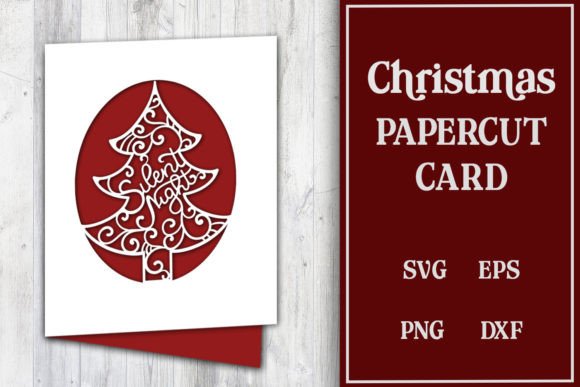
Christmas Card Papercut SVG
A Designer’s First Glance: Delicate, Festive, and Surprisingly Versatile
Opening Christmas Card Papercut SVG feels like unrolling a quiet holiday moment—no glitter bombs or loud reindeer, just elegant negative space, graceful swirls, and the gentle rhythm of “Silent Night” rendered in clean, papercut-inspired lettering. The central cutout Christmas tree anchors the composition, while decorative flourishes frame it without overwhelming. This isn’t a bold statement design—it’s a whisper of craftsmanship. As an embroidery designer who’s stitched hundreds of holiday motifs, I immediately sensed its potential: not for high-impact chest logos, but for pieces where subtlety reads as intentionality—think linen tea towels for a boutique kitchen line, baby onesies with minimalist charm, or embroidered patches sewn onto wool caps for local craft fairs.
How It Translates to Real Embroidery Projects
I tested Christmas Card Papercut SVG across three real-use scenarios: a medium-weight cotton tote bag, a 100% cotton baby bodysuit, and a twill apron for a small-batch bakery. On the tote, the design held its airy structure beautifully—the swirls translated into graceful satin-stitched curves, and the tree’s outline stayed crisp with minimal fill stitch density. Customers noticed it instantly—not because it shouted, but because it looked *designed*, not downloaded. On the bodysuit, I scaled it down to 3.2 inches wide and used lightweight tear-away stabilizer; the “Silent Night” typography remained legible (a win for tiny lettering), though I avoided stitching the finest inner swirls to prevent thread breakage on delicate knit fabric.
For the apron, I paired it with matte cotton thread in forest green and ivory—no metallics, no heavy fills. The result felt cohesive, handmade, and quietly premium. That’s where Christmas Card Papercut SVG shines: it elevates the *finished product* without demanding technical gymnastics. It works especially well as a machine embroidery design for personalized gifts—holiday cards you can literally stitch onto fabric—and as a digital embroidery file that supports brand consistency across small shop products like pillow covers or kitchen towels.
Where Caution Is Essential
This isn’t a one-size-fits-all embroidery file. Its strength is also its limitation: delicacy. Avoid using Christmas Card Papercut SVG on stretchy fabrics like jersey without proper cut-away stabilizer and reduced stitch density—it’ll pucker around those fine swirls. Dark fabrics demand careful thread color contrast testing; light ivory thread disappears on charcoal twill unless you add a subtle underlay. And curved surfaces? Caps and hats are tricky—the tree’s topmost point and thin lettering legs can distort if hooped too tightly or stitched without re-hooping support.
Also, don’t force it into tight spaces. If your hoop size is under 4 inches, skip the full layout and isolate just the tree or the “Silent Night” phrase. Tiny corners and overlapping swirls will clog with dense fill stitches, especially on textured fabrics like burlap or thick terry cloth. For commercial embroidery projects—say, wholesale holiday towels for a resort gift shop—I’d recommend simplifying the outer swirls into running-stitch accents rather than dense satin borders. Less density = better wash durability and cleaner presentation after repeated laundering.
What It Adds to Your Craft Business—Beyond the Stitch
As an Etsy seller and small shop owner myself, I pay attention to how a design affects buyer trust and perceived value. Christmas Card Papercut SVG reads as intentional, not generic. When customers see this on a handmade product, they don’t think “mass-produced clipart”—they sense care. That translates directly to willingness to pay a premium, repeat purchases, and social shares (“Look at this gorgeous quiet Christmas tote!”). It also pairs exceptionally well with printable mockups for digital product previews—its clean lines render crisply in black-and-white mockups, making it easy to show variations across light/dark backgrounds without visual noise.
For apparel decorators and embroidery studios, it’s a low-risk, high-reward addition to holiday collections. It doesn’t require special digitizing tweaks for most standard machines, and its balanced layout means fewer re-hooping stops mid-job. Just remember: always test on scrap fabric first. Check how the “Silent Night” letters hold up at your intended size. Confirm thread color contrast against both light and dark fabric swatches. And verify licensing—since this is listed under Graphics and Crafts, confirm whether commercial use of finished embroidered items is permitted before listing on Etsy or producing wholesale batches.
Practical Notes Every Embroidery Designer Should Keep Handy
- Test before committing: Run a sample on your target fabric + stabilizer combo—even if it’s just the tree outline.
- Thread colors matter more here than usual: Choose matte, low-sheen threads to honor the papercut aesthetic—avoid high-gloss rayon for this one.
- Review stitch density: If your embroidery software shows >12,000 stitches, simplify fine swirls manually or reduce fill opacity.
- Hoop size check: Measure the full design width *with seam allowance*—don’t assume it fits your standard 4x4 hoop.
- Inspect small details: Zoom in on the serif ends of “Silent Night” and inner tree branches—they’re beautiful but fragile in thread.
- Mock it in grayscale: A black-and-white printable mockup reveals balance issues faster than color.
- Stabilizer strategy: Use lightweight cut-away for knits, tear-away for stable wovens, and avoid fusible-only on thin fabrics.
- Commercial clarity: Since this is a digital embroidery file, double-check usage rights before selling embroidered patches or custom apparel at scale.
In short, Christmas Card Papercut SVG isn’t flashy—but it’s thoughtful, adaptable, and deeply rooted in craft sensibility. Used with intention, it becomes more than decoration. It becomes a quiet signature for your handmade product, your holiday gift, your small shop’s seasonal voice.