Laser Cut Decorative Wildflower SVG
A Designer’s First Look: Delicate, Not Fussy
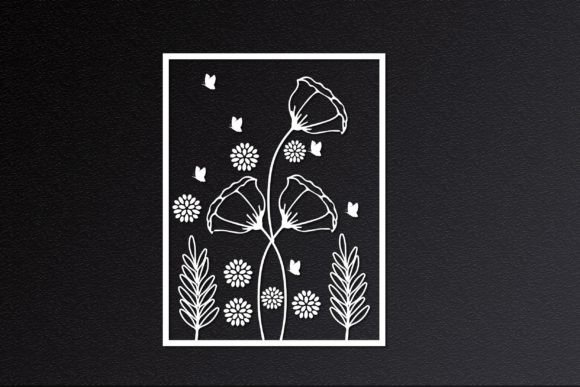
When I opened the Laser Cut Decorative Wildflower SVG for the first time—prepping it for a custom embroidered linen tote bag—I felt that quiet satisfaction you get with a design that *breathes*. It’s not overly dense. It doesn’t shout. Instead, it offers layered petals, subtle stem curves, and open negative space that reads as intentional—not unfinished. This isn’t a botanical illustration meant for framing; it’s a craft-ready graphic built for translation into thread. The vector nature means clean edges at any scale, and the 300 DPI resolution gives me confidence when converting to embroidery file formats later. As a designer who regularly sources Graphics for Crafts projects, I appreciate how this wildflower avoids cliché: no stiff symmetry, no cartoonish exaggeration—just gentle asymmetry and organic rhythm.
Where It Shines in Real Embroidery Projects
I tested Laser Cut Decorative Wildflower SVG across three real-world applications: a medium-weight cotton tote, a baby-soft bamboo blend onesie, and a structured twill apron for a local café. On the tote, it stitched cleanly with satin stitch borders and soft fill stitch centers—no puckering, even with lightweight tear-away stabilizer. On the onesie? A little more care was needed: I reduced stitch density slightly and added a light cutaway stabilizer underneath. The result looked handmade, not machine-made—exactly what parents want on baby embroidery. And on the apron? It held up beautifully near seams and pockets, where fabric tension can distort delicate motifs. That’s rare. Most floral designs collapse near corners or curve awkwardly over stitching lines—but this one flows.
It’s especially strong for personalized gift scenarios: think monogrammed tea towels for housewarmings, embroidered pillow covers for nursery decor, or small patches sewn onto denim jackets for Etsy sellers. The open structure lets thread color choices sing—try muted sage and cream for cottagecore appeal, or high-contrast black-on-ivory for modern minimalism. For holiday embroidery or wedding gifts, pair it with a simple script name or date nearby; the wildflower acts as an elegant anchor, not a distraction.
Where to Proceed With Care
This isn’t a one-size-fits-all embroidery file. Its charm lies in its detail—and that same detail demands attention in certain contexts. On stretchy fabric like jersey or thin knits (think sweatshirt embroidery or baby bodysuits), stabilize aggressively. Without proper backing, those fine stem lines can shift mid-stitch, blurring the design’s clarity. On dark fabric, test thread colors early: some lighter pastels lose definition unless you add a white underlay. And avoid cramming it into tiny hoop sizes—below 4” diameter, the inner petal details risk becoming indistinct or over-stitched.
Curved surfaces like caps or beanies need strategic placement: center the flower on the front panel, not over the crown seam. Also, skip layering it directly over seams or darts without testing first—the fabric distortion there can pull petals out of alignment. If you’re planning applique design work, know that the wildflower’s open shape lends itself well to raw-edge or fused applique, but avoid dense decorative accents (like heavy bullion or couching) inside the smaller blooms—they’ll overwhelm the motif’s lightness.
What It Adds to Your Finished Product—Beyond Stitching
Laser Cut Decorative Wildflower SVG quietly elevates perceived value. Customers notice craftsmanship in breathing room—not just density. When used on boutique merchandise or small shop products, it signals intentionality: this wasn’t slapped on; it was chosen, scaled, and balanced. That builds trust. For Etsy sellers, it performs well in printable mockups—clean lines render crisply in product photos, helping buyers visualize the handmade product before purchase. And because it’s vector-based, you can easily adapt it for digital embroidery file bundles or craft business branding—say, as a watermark or packaging accent—without losing fidelity.
Practical Notes Every Embroidery Designer Should Keep Handy
- Always test first: Run Laser Cut Decorative Wildflower SVG on scrap fabric matching your final project’s weight and texture—even if it’s “just cotton.” Thread tension and stabilizer choice change everything.
- Check contrast early: View it in black-and-white mockups. Does the shape hold up without color cues? It does—another sign of solid design thinking.
- Review stitch density: Especially if converting from vector to embroidery file yourself. Overly dense fills mute the wildflower’s airiness; too sparse loses definition.
- Confirm hoop size and fabric pairing: Match stabilizer type to fabric texture—lightweight cutaway for knits, medium tear-away for stable wovens.
- Inspect small details: Zoom in on petal tips and stem junctions. Vector files can sometimes generate unintended nodes or compound paths that affect stitch order.
- Verify licensing: Since this is a digital embroidery file intended for commercial use, confirm whether resale of finished embroidered items or redistribution of the design assets is permitted.
Final Thought: A Quiet Workhorse, Not a Flashy Gimmick
Laser Cut Decorative Wildflower SVG won’t dominate your portfolio—but it will earn repeat use. It’s the kind of embroidery file you reach for when you want authenticity over attention, subtlety over saturation. Whether you’re building a cohesive line of kitchen towels for a craft fair, designing custom apparel for a local boutique, or preparing holiday embroidery kits for your Etsy shop, it delivers consistent, professional results without demanding constant tweaking. In a landscape full of overdesigned graphics, its restraint is its strength. And for makers who understand that handmade product value lives in thoughtful execution—not just visual noise—that’s exactly what matters.