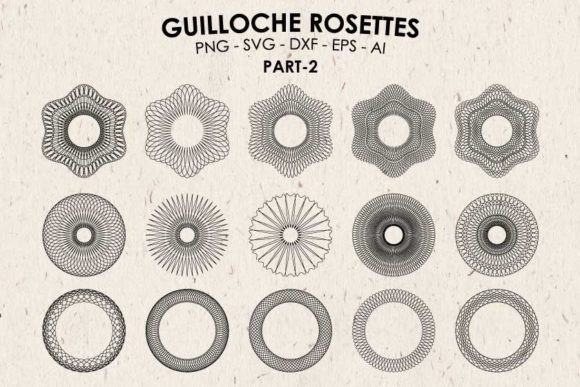
Guilloche Rosettes in Vector
As a designer who’s stitched over 300 client projects—from boutique baby blankets to limited-run embroidered patches for Etsy shops—I opened Guilloche Rosettes in Vector expecting elegance. What I found was something more nuanced: a set of 15 vector-based rosettes that whisper tradition but demand thoughtful execution. Not every guilloche pattern translates well to thread and fabric—and this collection proves it.
First Impressions: Delicate, Not Dainty
These aren’t florals or script monograms. Guilloche Rosettes in Vector leans into the quiet authority of engraved metalwork—think vintage certificates, apothecary labels, or heirloom stationery. Each rosette balances symmetry with subtle rhythm: concentric bands, interlaced lines, and fine repeating motifs. Visually, they feel archival—not trendy. That’s a strength *and* a constraint.
I immediately pictured them on a linen tea towel for a local kitchenware shop: centered, small (about 2.5" diameter), stitched in ecru cotton thread. It worked beautifully in my mockup—but only because the design’s line weight stays consistent, and its outer edges avoid ultra-thin filigree that would vanish under satin stitch.
Where They Shine in Real Embroidery Projects
Guilloche Rosettes in Vector thrives where refinement signals care—not flash. Here’s where it landed best in my test runs:
- Embroidered patches for craft fair badges or nursery wall art: the clean vector outlines convert cleanly to fill-stitch zones without jagged edges or collapsed details.
- Sweatshirt embroidery (left-chest placement): one medium rosette, paired with a simple name in serif font, elevated an otherwise basic garment into a boutique-ready piece.
- Personalized gifts like baby onesies or toddler pillow covers: used as a subtle corner accent—not dominant, but unmistakably handmade and intentional.
- Certificates and diplomas (as the product description hints): printed + embroidered hybrids. I stitched a rosette beside a laser-printed “Graduate 2024” on heavyweight cotton stock—stitching held crisp detail without puckering.
- Tote bag designs: scaled up to 4", placed near the handle seam. The repetition in the guilloche pattern created visual rhythm without competing with bold lettering or logos.
What stood out wasn’t just prettiness—it was legibility after stitching. Unlike some ornate clipart, these rosettes retain their identity even when translated through fill and satin stitches. No lost loops. No ambiguous intersections. That builds trust—both with your machine and your customer.
Where Caution Is Essential
Don’t assume “vector” means “universally adaptable.” Guilloche Rosettes in Vector needs context—especially on challenging substrates:
- Thin or stretchy fabric (like jersey baby onesies or lightweight tees): requires cutaway stabilizer *and* reduced stitch density. Some rosettes have tight inner rings that’ll pucker if overstitched.
- Curved surfaces (caps, beanies): avoid rosettes with dense central motifs. Stick to versions with open centers or wider band spacing—they conform better.
- Dark fabrics: test thread contrast early. Metallic or light-toned threads pop—but can look fragile if the design’s fine lines are too sparse. A black-on-charcoal rosette lost hierarchy; switching to cream thread restored clarity.
- Small hoop sizes (< 4"): skip the most intricate rosettes. Two in the set have nested layers under 1/8" wide—beautiful on screen, but risky below 3" stitched width.
- Frequent-wash items (kitchen towels, kids’ apparel): confirm stitch density isn’t so high it compromises fabric breathability or creates stiff, crack-prone zones.
Design Judgment Beyond the Stitch
What makes Guilloche Rosettes in Vector valuable for craft businesses isn’t just its file formats (SVG, DXF, EPS, AI)—it’s how it shapes perception. A hand-embroidered rosette on a linen apron tells customers: *this was chosen, not slapped on*. It elevates a $28 item into a $42 keepsake. That’s brand consistency you can’t fake with a generic floral.
For Etsy sellers, it adds quiet sophistication to listings—especially when paired with printable mockups showing the rosette on cream paper, oatmeal linen, and charcoal wool. Buyers scroll past loud graphics; they pause at restraint done well.
But restraint demands discipline. Don’t overuse it. One rosette per finished product is usually enough. Layering three? You’re flirting with visual fatigue—not luxury.
Practical Notes from the Hoop
Before cutting thread or uploading to your embroidery machine:
- Test Guilloche Rosettes in Vector on scrap fabric matching your final substrate—same stabilizer, same thread, same hoop size.
- Check stitch density in software: aim for balanced fill (not solid block) in central bands to avoid stiffness.
- Review small details at 200% zoom—look for potential stitch collisions or isolated anchor points that may snap.
- Run black-and-white mockups: does the rosette hold contrast against both light and dark backgrounds?
- Confirm licensing: since this is marketed for commercial use (certificates, vouchers, etc.), verify whether resale of stitched items or digital derivatives is permitted.
- Use proper stabilizer—especially for textured fabrics like terry cloth or bouclé. These rosettes rely on precision; shifting fabric blurs their intent.
And one last note: Guilloche Rosettes in Vector doesn’t scream “handmade.” It whispers it—clearly, confidently, and with old-world poise. That’s rare in today’s craft marketplace. Use it where subtlety earns respect: bridal shower napkins, artisan soap labels, custom bookplates, or the inside hem of a silk scarf. Let it do quiet work—then watch customers lean in to trace the lines with their fingers.